How to Craft Website Copy That Converts Readers into Clients
You can spend hours tinkering with your website copy and still have absolutely no idea whether it’s any good.
I’ve been there. You change the headline, read it back, change it again, decide the first version was better and eventually give up because you’ve looked at the word “services” so many times that it no longer looks like a real word.
The problem is that we tend to judge our own copy by how it sounds. Does this sound professional enough? Is this sentence a bit boring? Should I use a better word here?
Your potential clients are thinking about something completely different.
They want to know whether you can help them, whether you understand what they’re looking for and whether they trust you enough to hand over their money.
That makes writing website copy that converts a lot less about finding the perfect words and much more about knowing what needs to be on the page in the first place.
DIYing your website copy & SEO doesn’t have to be overwhelming.
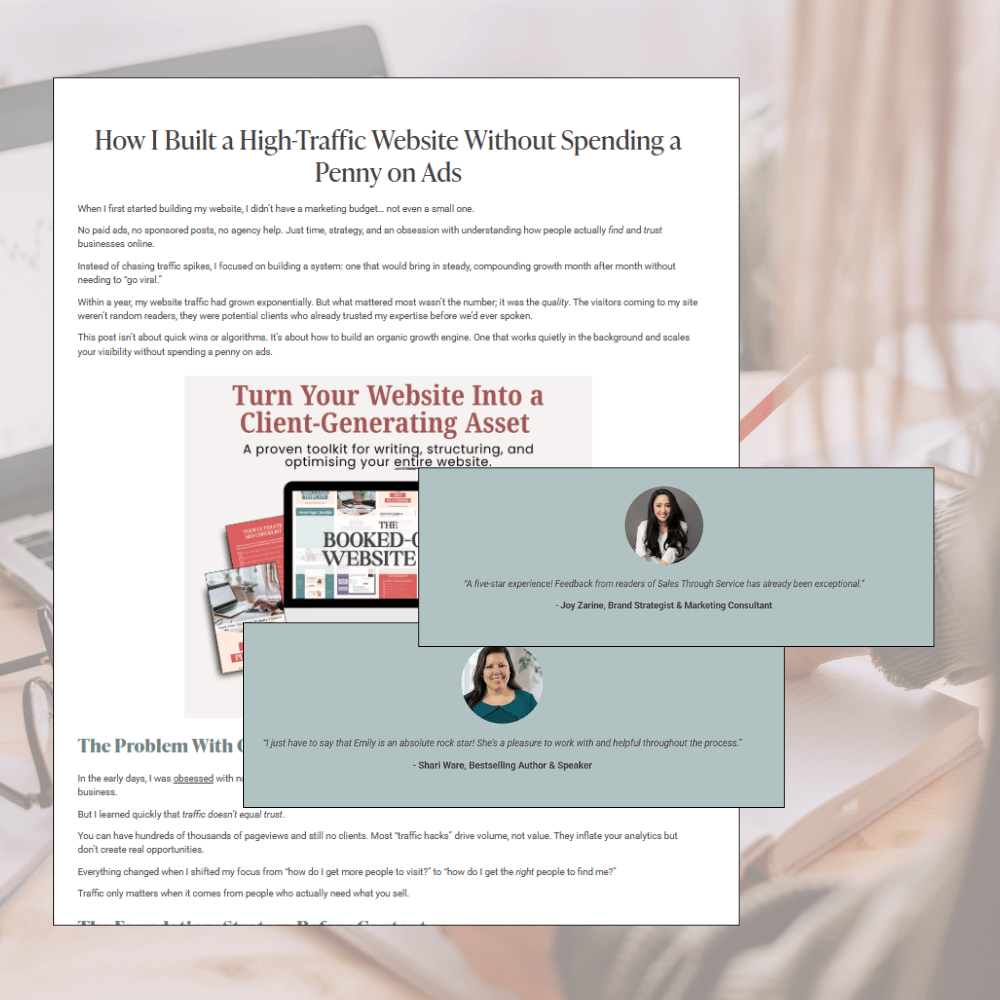
The Website Growth System walks you through how to write high-converting copy and optimise your entire website so you can confidently boost traffic, inquiries, and sales. Packed with templates, copywriting scripts, and tutorials, it’s everything you need to make your website shine on a budget.
1. Start with Positioning, Not Phrasing
The biggest mistake most business owners make when writing website copy is starting too soon. They open a blank page, try to sound “professional,” and end up with something that feels polished but hollow.
Strong copy doesn’t start with words. It starts with positioning.
Before you write anything, you need absolute clarity on three things:
Who you help: Your audience and what they care about most.
What you do: Your offer and why it matters.
Why it’s different:Your differentiator, the reason someone should choose you over another option.
Once you can articulate that, the copy almost writes itself. Every headline, paragraph, and button becomes a natural extension of your positioning.
Because you simply can’t sell what you can’t articulate, and you can’t articulate what you don’t fully understand.
2. Lead with Value, Not Features
Your reader doesn’t care what you offer, they care what it does for them.
Most websites list features: the number of sessions, deliverables, or software used. But people don’t buy processes; they buy outcomes.
Instead of saying:
“I offer monthly strategy sessions and a detailed analytics report”
say:
“You’ll have a clear marketing plan that grows with your business and the data to prove it’s working.”
See the difference? The first tells. The second translates.
That’s the key to high-converting copy; every feature should lead to a feeling or result. Features build logic. Benefits build desire.
And when your copy connects both, you create momentum, the sense that taking the next step just makes sense.
3. You/Your > I/My
There’s a delicate balancing act between showcasing your expertise and tailoring your content to your ideal client.
People want to read anecdotes, real-life stories, and your experiences. But they also want to feel like your content is there to help them, not sell your product.
Take a look at your service page, blog, or homepage. Are you using “I” and “My” more than “You” and “Your”?
Do a content review and make sure most of your content is focused on your client by shifting the perspective.
“My service” becomes “Your solution”
“I can help” becomes “You’ll receive”
“I offer X service” becomes “The perfect service for you”
4. Map Your Reader’s Journey
Every website visitor arrives with a question in mind: “Is this for me?”
Your job as the writer is to guide them from curiosity to clarity (from interest to action) without making them work for it.
Think of your website like a story:
The homepage establishes relevance.
The about page builds connection.
The services page proves value.
The CTA gives them direction.
When those pages flow logically, the buying decision feels effortless.
Before you publish, read through your site as if you were a potential client. Does every section answer the right question at the right time? If not, re-order the information so the story makes sense.
4. Write for Skimmers, Win the Readers
Most visitors won’t read every word, at least not at first. They’ll scan your headlines, glance at your subheadings, and make a snap judgement in seconds.
That’s why formatting is part of strategy.
Use short paragraphs, clear headlines, and plenty of white space.
Make your key phrases bold or stand-alone.
Ensure that even someone who skims gets the full message.
When your structure is clean and intentional, it earns a second read, and that’s where real engagement happens.
5. Make Proof and Personality Do the Heavy Lifting
The most persuasive copy doesn’t rely on adjectives — it relies on evidence.
Proof builds credibility; personality builds connection. When you combine both, you make your brand memorable and trustworthy.
Add testimonials, case studies, data points, or recognisable clients, anything that shows you’ve done what you claim to do. Then layer in personality: tone, rhythm, and voice that sound unmistakably yours.
People don’t buy from “the best.” They buy from the brand that feels right.
7. Cut the Fluff
When I was a non-fiction book editor, 90% of my job was cutting fluff from manuscripts. Someone would submit a 50K-word book, and I’d give it back with just 30K words left.
Fluff is all the unnecessary website copy that makes your point fuzzy. It’s the tangents, extra information, filler words, and over-explanations.
We use fluff in conversation because we’ve got so much extra time to communicate. But you don’t have that luxury on your website.
Your readers want concise answers to their questions. Too much extra fluff, and you’ll lose their attention.
But it’s tough spotting fluff in your own writing. That’s why editors exist!
During website audits, I highlight all the fluff and show my clients how to communicate their points more effectively.
If you want to DIY it, read through one of your blogs pretending you’re a stranger who has just found this website.
Does it get to the point and give concise value? Or could you cut out chunks without losing any real coherency?
The more you write and edit your website copywriting, the better you’ll get at avoiding fluffy writing.
Related: 10+ Benefits of Blogging as a Service Provider
8. Stop “Injecting” Personality
I’ve always found it strange that content strategists tell you to “inject personality into your copy”.
Imagine trying to “inject” personality into conversations with people. You’d end up sounding like a caricature of yourself.
You already have a unique personality, whether it’s bubbly and funny, dry and witty, or serious and to the point.
You don’t need to force personality into your copy. Instead, give yourself the freedom to write and allow your unique personality to shine through naturally.
If you’re naturally funny, it will come through in your website copywriting. If you’re naturally more serious, that’s what your website copy will be. You don’t need to inject it in like a shot at the doctor’s office.
The worst thing you can do is try to force a personality you don’t naturally have. People binge authentic content, so be true to who you are.
Not everyone will resonate with your style of content, but you’ll quickly find the loyal tribe that loves your personality and how it shines in your copy.
6. End with Direction, Not Desperation
Every page should end with one clear next step, not just a vague “learn more.”
Your call-to-action isn’t pushy when it’s purposeful. If your reader has spent time with your content, they want to know what comes next.
Be clear, confident, and conversational:
“Book your strategy session.”
“Explore our services.”
“Start your project.”
Each CTA should feel like a natural continuation of the conversation you’ve just had.
Still Struggling to Write Website Copy?
There’s no shortcut for writing website copy that’s binge-worthy. Your first few blogs will suck, your first draft service page won’t convert, and you’ll want to give up.
But the more you write, the better you get. You’ll develop a unique writing style as you go, and eventually, copywriting will be second nature.
Of course, even the experts need some help, so here are my must-have copywriting tools to make creating blogs insanely easier.