How to Makes Sales with Old Blog Posts
Are your old blogs working hard for your website? Or are they sat deep in your archives going stale and gathering dust?
High-value clients should be able to find you through your old content. Because if should keep showing up on Google long after you hit publish.
But here’s the thing, every old blog won’t keep ranking just because it’s on your website. It takes work to make sales with old blog posts.
In this post, I’ll break down how I intentionally structure and maintain older content so it continues to drive results long-term.
DIYing your website copy & SEO doesn’t have to be overwhelming.
The Website Growth System walks you through how to write high-converting copy and optimise your entire website so you can confidently boost traffic, inquiries, and sales. Packed with templates, copywriting scripts, and tutorials, it’s everything you need to make your website shine on a budget.
Does Google Rank Old Blog Content?
Yes! Google absolutely ranks old blog content. In fact, some of the highest-ranking pages online are years old.
When I google “how to do yoga for beginners”, the first organic link is from 2023:
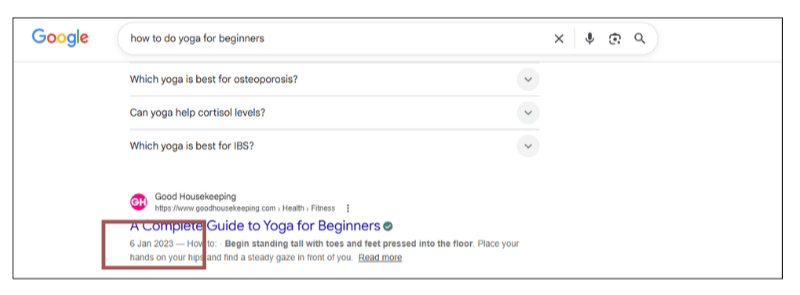
Google doesn’t care whether a blog post was published last week or five years ago. What it cares about is whether the content is still useful, relevant, trustworthy, and satisfying search intent.
That’s why older blog posts can continue bringing in traffic and sales long after they’re published, especially if they’ve been updated, improved, and kept relevant over time.
Google has even confirmed that content freshness matters more for some topics than others. For example, a blog about “best SEO strategies for 2026” needs regular updates, while evergreen content can rank consistently for years with only minor improvements.
How to Make Sales from Old Blog Posts
If you have old blogs gathering dust on your website, here’s how you can dust them off and turn them into sales assets that rank on Google, get clicks, and turn readers into clients.
1. Focus on Evergreen Content
If you’ve got old posts that were relevant years ago but haven’t lived up to the test of time, let them sit peacefully in your archives. For example:
News articles linked to time-sensitive events (e.g., How the 2020 Olympics Shaped Viral Marketing)
Business updates that aren’t relevant anymore (e.g., We’ve Added a Brand-New Chatbot to Our Website!”)
We want to focus on updating and refreshing evergreen content—the stuff that is still as relevant today as the day you wrote it.
2. Refresh, Don’t Rewrite
You don’t need to go back and rewrite entire blog posts to get them ranking again. Every few months, I review my top-performing posts using tools like Google Search Console to see what’s ranking, what’s slipping, and where new search trends are emerging.
Then, instead of starting from scratch, I refine:
Update examples or statistics.
Improve the call to action based on current offers.
Add new insights or opinions if things have changed.
These micro-optimisations keep each post alive, relevant, and profitable without losing the organic traction it’s already earned.
Google views these updates the same as newly published posts. It shows you’ve looked at the content, confirmed it’s still relevant, and are actively working on your website, all of which are great ranking signals.
3. Add Better Headings
Sub-section headings should be clear, SEO-optimised, and easy to scan. If your blog has great content but lacks sub-headings, now is the time to add them in to give the blog a fresh feel.
Sub-headings help boost SEO with Google, but they also make the post much easier to read for visitors. And if your content isn’t easy to read, visitors won’t stick around.
If you already have headings, make sure they have your keyword integrated and are focused on answering specific questions or giving real value.
4. Target Better Keywords
This is my favourite way to make sure old blogs are making sales consistently.
Go to your Google Search Console and see what keywords you’re already ranking for (even if the rankings are low and you’re not getting clicks). These are the terms Google is already associating with your brand, so they’re the easiest ones to rank for.
If I discover I’m ranking low for a specific keyword, I’ll find the blog and optimise it better:
Add the keyword to sub-section headings.
Add the keyword to image ALT text.
Sprinkle it in naturally in the body text.
Add a FAQ targeting that specific keyword at the end of the post.
Related: Blog SEO Checklist: 15 Steps to Optimise Every Post
5. Update Internal Links
This one is huge for SEO, and the one most service providers never bother to do.
Old blogs should have links to your newer content to improve your internal linking structure.
One a month, go back through a few old blogs and add new links to your newer content. Wherever you can, use the keyword of the new post as the anchor text of the link. That will give the new post an SEO boost!
6. Add an FAQ section
If your blog doesn’t already have an FAQ section, add one in your blog writing refresh. It’s a great way to boost SEO, especially in AI searches.
I like to add accordion-style FAQs so they look a little cleaner and don’t take up loads of space at the end of my blogs. And if an old blog already has one, I’ll update a question or add a new one to give it a boost.
7. Add a Case Study
If you’ve had a new client since you posted the blog and it fits the topic, add it in as a case study!
Lived experience is a massive ranking signal for Google, so this will boost your authority. Bonus points if you can include a screenshot or real results that show how great your services are.
Remember, we’re not just refreshing old blogs to rank on Google, we also need to turn casual readers into paying clients. Case studies are a great way to establish trust in your services.
Related: The New SEO: Why Trust and Expertise Matter More Than Keywords
8. Re-promote your refreshed content
Once you’ve put all the work into updating an old blog, show it off!
Share it on social media
Create new pins for Pinterest
Send it to your email list
I like to make it clear that it’s an old blog that I’ve refreshed with new ideas and insights, so it’s worth clicking to see what’s changed.
Do You Use Old Blogs to Make Sales?
Refreshing old blog content is one of my favourite content marketing tasks. It’s like redecorating a room and seeing it look all fresh and new.
Plus, it’s much easier and quicker than writing a brand-new blog. So, if you haven’t updated your older blog content in a while, this is your sign to make them start working for your website again!